Methodology
To make the most of the World Inequality Database (WID), we encourage our users to consult a selection of key resources. These include our methodology guidelines and various informative pages designed to help you understand how our variables are constructed and the steps to download our data.
METHODOLOGICAL RESOURCES
- Distributional National Accounts (DINA) Guidelines: This is a resource to understand the methodology behind the decomposition of National Accounts and the estimation of inequality series for income and wealth.
- Codes Dictionary Page: A key reference for understanding the structure of the WID database and the construction of its variables.
- Gpinter Tool: Designed for users interested in estimating income and wealth distributions from raw data, the gpinter tool is accessible both via a web interface and as an R package.
WID LIBRARY
- Working Papers are research articles produced by WID fellows that present and discuss new inequality series for specific countries or at the global level, or focus on general developments of the WID methodology. They are intended to make findings of the WID community available to researchers and the general public and to encourage discussion.
- Technical Notes are shorter documents aimed at providing additional technical information about our series (typically about updates of previously released series).
- Replication Packages are the datasets and code used to replicate key results published by the WIL.
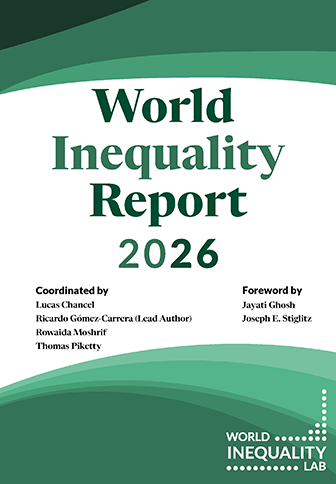
- The World Inequality Report 2026 represents the most up-to-date synthesis of international research efforts to track global inequalities. Every four years, we publish this report with the aim to fill a democratic gap and equip citizens with the necessary facts to engage in informed public debates on inequality.
DATA DOWNLOAD
Depending on your needs, there are two main ways to access the data:
- Direct Download: Our user-friendly data page allows you to browse and download datasets directly in the format that best suits your work. Use the left-hand menu to select the data
you need. - Statistical software: For more technical users, data can also be accessed through STATA and R. Comprehensive documentation is provided to guide you through these methods.
To ensure full transparency, we make available the full set of WID.world computer codes used to construct the database from both researchers’ data and official sources.
These codes are regularly updated and accessible via GitHub.
All these resources are designed to make the WID.world database as accessible and useful as possible for users of all backgrounds. For further general questions, feel free to contact us at info@wid.world, for specific questions about our statistical packages, please use stats@wid.world.
TRACKING ECONOMIC INEQUALITIES AT THE TOP… AND BELOW
Over the past decades, the increase in economic inequalities was largely driven by a rise in income and wealth accruing to the top of the distribution. However, household surveys, the data sources traditionally used to observe inequality dynamics, do not properly capture these evolutions. Surveys provide useful information and cover many countries, but they do not inform adequately on income and wealth levels of the richest individuals.
The WID overcomes this limitation by combining different data sources: national accounts, survey data, fiscal data, and wealth rankings. By doing so, it becomes possible to track more precisely the evolution of all income or wealth levels, from the bottom to the top. The key novelty of the WID is to use such data in a systematic manner, allowing comparisons between countries and over long time periods. In order to achieve this objective, we build upon the new wave of research on long-run inequality trends developed during the past 15 years by an international group of scholars.
BEYOND GDP: DISTRIBUTIONAL NATIONAL ACCOUNTS
Comparing concepts of income and wealth in different countries and over time is not straightforward. The concept of gross domestic product (GDP) that is commonly used to compare levels of economic welfare across countries is not satisfactory. We prefer the concept of national income (NI), i.e. GDP minus consumption of fixed capital (capital depreciation) plus net foreign income. National income is more meaningful because it takes into account the depreciation of the capital stock (including in principle natural capital), which is not an income to anyone, as well as the fraction of domestic output that is transferred to foreign capital owners (including in principle offshore wealth). For instance, a country with a large GDP but extensive capital depreciation and foreign outflows does not have much income to distribute to its residents and citizens. The national income concept reflects this.
Next, and most importantly, the central problem of gross domestic product (total and per capita) is that it deals solely with aggregates and averages: it does not tell us anything about the extent to which the different social groups benefit – or not – from economic growth.
In contrast, the WID develops a methodology based upon the notion of Distributional National Accounts (DINA). The central objective is to describe the evolution of the distribution of national income and wealth, i.e. how the different percentiles of the distribution – from the bottom to the top – evolve over time and across countries, using concepts of income and wealth that are socially and economically meaningful and comparable across countries.
MAKING EXPLICIT WHAT WE KNOW AND DO NOT KNOW
We are very much aware that there are strong limitations to our ability to measure the evolution of income and wealth inequality. Our objective is not to claim that we have perfect data series, but rather to make explicit what we know and what we do not know. We attempt to combine and reconcile in a systematic manner the different data sources at our disposal: national income and wealth accounts, household income and wealth surveys, fiscal data coming from taxes on income, inheritance and wealth (when they exist), wealth rankings.
None of these data sources and associated methodology is sufficient in itself. In particular, we stress that our ability to measure the distribution of wealth is limited, and that the different data sources at our disposal are not always fully consistent with one another. But we believe that by combining these data sources in the most explicit manner we can contribute to a better informed public debate. The research papers upon which our series are based are available on-line and present our methods and assumptions in the most transparent manner. All raw data sources and computer codes are released so that our work can be extended and improved by others.
PRESSURING GOVERNMENTS SO AS TO RAISE FINANCIAL TRANSPARENCY
The Inequality Transparency Index is a collaborative tool, updated annually, that provide an assessment of the state of inequality data availability and quality around the world.
We also aim to put pressure on governments and international organizations so as to induce them to release more raw data on income and wealth. In our view, the lack of transparency about inequality of income and wealth is one of the greatest challenges to peaceful democratic discussion in today’s globalized economy.
In particular, it is critical that governments provide public access to reliable and detailed tax statistics, which also requires that they operate a properly functioning registration system for income, inheritance and wealth. Short of this, it is very difficult to have an informed debate about the evolution of inequality and what should be done about it.
In recent years, we were able to gain improved access to income and wealth fiscal data in a number of countries in Asia, Latin America, Africa, Europe and North America, including China, India, Brasil, Russia, Mexico, India, Lebanon, Ivory Coast and South Africa. But this is still insufficient, and we very much hope that we will be able to provide better series in the future.