Land is one of the most important productive assets in agrarian societies, yet its distribution remains highly unequal across many parts of the world. Rural India, where hundreds of millions of people depend on agriculture for their livelihoods, provides a particularly important setting to examine how natural conditions, historical institutions, and market forces shape land inequality.
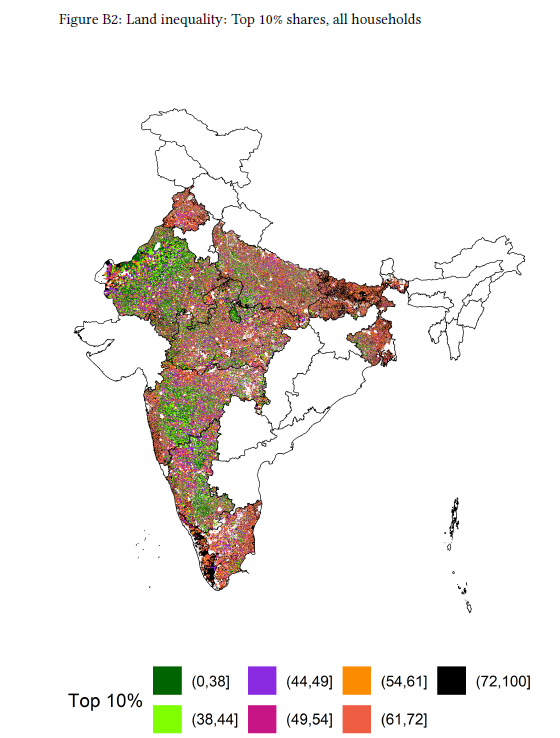
In this paper, Nitin Kumar Bharti, David Blakeslee, and Samreen Malik combine village-level landownership data from the 2011 Socio-Economic and Caste Census (SECC) with information on agro-climatic conditions, colonial land tenure systems, caste composition, and market access. Covering approximately 270,000 villages and around 650 million people across ten major Indian states, the paper studies how differences in natural agricultural productivity (“nature”), historical institutions (“history”), and economic integration (“markets”) shape contemporary patterns of land inequality across rural India.
KEY FINDINGS
- Landholding inequality in rural India is extremely high. The average village land Gini reaches around 71 (on a 0–100 scale) when including landless households, while about 46% of rural households are landless. In terms of top shares, the top 10%, top 5%, and top 1% households own 44%, 32% and 18% of total land area. The diversity of land inequality levels across Indian states is almost as large as that between countries at the world level.
- Agricultural productivity is strongly associated with higher land inequality. Villages with more favorable agro-ecological conditions tend to exhibit greater land concentration, increasing the share of land controlled by large landowners.
- Historical institutions leave persistent effects on land distribution. Areas historically governed under landlord-based colonial land tenure systems tend to display higher levels of land concentration today. Also, the villages falling under the direct-rule of British colonialism tend to have higher land inequality compared to those which were under Indian rulers.
- Social stratification also shapes land ownership. Villages with higher shares of Scheduled Castes and Scheduled Tribes tend to exhibit higher rates of landlessness, reflecting the enduring role of social hierarchies in structuring access to productive assets. The notable exception is in Kerala and West Bengal, which are long governed by left-wing parties.
- Market access does not fully eliminate historically rooted inequalities. Proximity to towns, roads, and markets appears insufficient to overturn deeply embedded patterns of land inequality shaped by natural conditions and institutional history.
- Large landholders dominate land ownership in many villages. On average, the largest landholder controls about 12% of village land, and in some villages a single owner controls more than half of all agricultural land
- Public goods provision rises with moderate inequality but falls at very high levels: villages with some inequality may receive more public goods, but where a single landlord dominates, public goods provision tends to be lower.
AUTHORS
- Nitin Kumar Bharti, University of Western Australia, World Inequality Lab
- David Blakeslee, New York University Abu Dhabi
- Samreen Malik, New York University Abu Dhabi