The long-run evolution of wealth has been central to debates in economic history and macroeconomics, but until now evidence has been largely confined to Western economies. Recent advances in historical national accounting make it possible to trace how wealth has been built, owned, and redistributed worldwide.
In this paper, Luis Bauluz, Pierre Brassac, Jonas Dietrich, Clara Martínez-Toledano, Gastón Nievas, Moritz Odersky, Thomas Piketty, Alice Sodano, and Anmol Somanchi construct the first global database of wealth accumulation covering 1800–2025. Drawing on national balance sheets from statistical offices and central banks, combined with newly reconstructed historical series for both advanced and developing economies, they study wealth-income ratios, capital-output ratios, ownership structures, and capital shares across all world regions.
KEY FINDINGS:
- The “Kaldor facts” do not hold globally. Wealth-income and capital-output ratios are not stable constants but vary greatly across countries and over time – even more so than previous research focusing on wealthy countries had already shown.
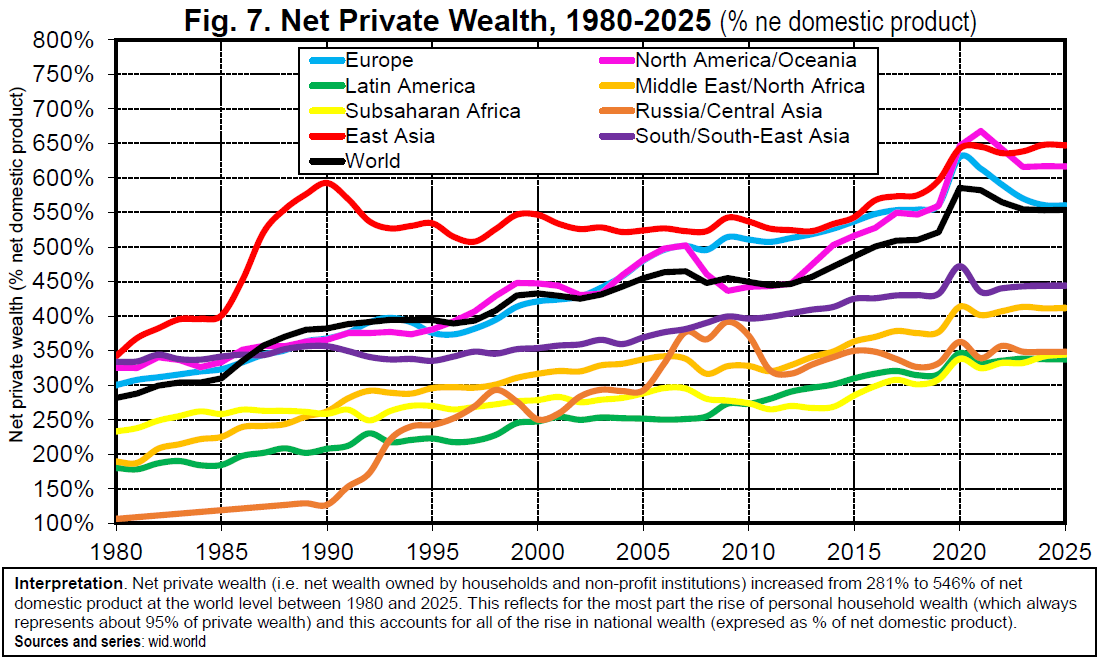
- Wealth has risen much faster than income since 1980. Global wealth-income ratios have risen dramatically from about 390% of world net domestic product in 1980 to over 625% in 2025. This surge reflects both higher savings and strong capital gains, especially in housing and equity markets.
- Private wealth is at record highs in all advanced regions. Public wealth, by contrast, has turned negative in North America, fallen near zero in Europe, while East Asia stabilized with 25–30% of national wealth in public hands.
- Capital shares have increased worldwide and remain systematically higher in emerging and poor regions. However, they have risen less than national wealth-income ratios. As a result, average returns to capital declined moderately, from 7.5% to 5.6%, yet remained well above income growth rates.
- Over the long run, global wealth has swung repeatedly: capital-output ratios rose from ~400% in 1800 to 500% in 1910, dropped to 300% by 1950, and rebounded to today’s peak of 600–650%. Foreign ownership shifted from European dominance (1800–1914), to U.S. leadership (1920–1970), to East Asia and oil-rich states today. Public-private splits also fluctuated widely.
- These large historical and regional variations appear to be explained primarily by changing ideology, political power, and institutions, rather than purely economic or technological factors — a lesson that matters for the ongoing climate and energy transition.
 |
 |
 |
 |
 |
 |
 |
 |
 |
 |
 |
 |
 |
 |
 |
 |
 |
This paper is the fourth in a series of research papers and technical notes that will form the backbone of the Global Justice Report, due to be released in June 2026.
AUTHORS
- Luis Bauluz, WIL, PSE and CUNEF (Madrid)
- Pierre Brassac, WIL, PSE, and UC3M (Madrid)
- Jonas Dietrich, WIL, PSE
- Clara Martínez-Toledano, WIL,PSE and Imperial College (London)
- Gastón Nievas, WIL, PSE
- Moritz Odersky, WIL, PSE
- Thomas Piketty, WIL, PSE
- Alice Sodano, WIL, PSE
- Anmol Somanchi, WIL, PSE
MEDIA CONTACT
- press[at]wid.world