How does the international system actually work in practice? Who holds decision-making power, who finances global public goods, and who ultimately benefits from them? More broadly, does institutional design matter for global outcomes—and does it reduce or reinforce global inequalities?
In new research, Paula Druschke and Gastón Nievas study the global public system over the past century. They build a novel dataset covering the finances and governance of major international organizations from 1920 to today. This includes the League of Nations, the United Nations and its specialized agencies (such as WHO, WTO, ILO, UNESCO), the Bretton Woods institutions (IMF, World Bank), the European Union, and major regional development banks. The data track contributions, spending, lending, capital subscriptions, and—crucially—voting power. This allows a direct link between how institutions are governed, how resources are raised, and how they are allocated.
KEY FINDINGS:
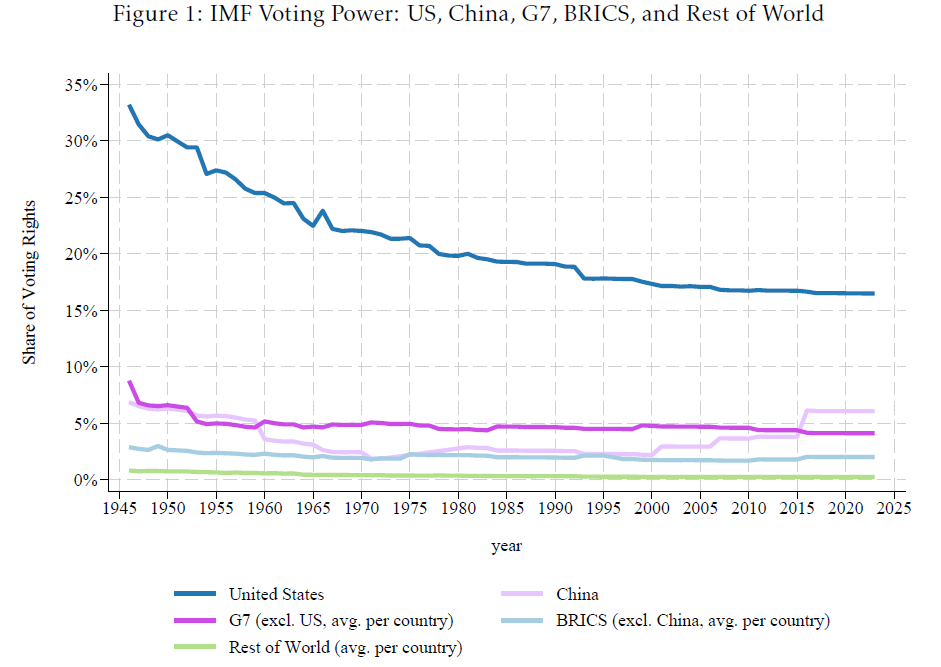
- Who holds power depends on institutional design—and this has direct distributional consequences. In many financial institutions, voting rights are effectively “priced”: influence is tied to financial contributions. In these systems, richer countries are able to acquire voting power at a much lower relative cost. The USA holds 16.6% of IMF voting power; the G7 together account for 41%, and when including other rich economies this rises to around 70%, while paying 26 times less per vote (as a share of GDP) than poorer countries. In other words, if a poor country were to match the voting power of a rich country contributing 1% of its GDP, it would need to contribute 26% of its GDP. This pattern is not specific to the IMF; it is also observed in the World Bank (IBRD) and other multilateral development banks. This also translates into regressive burden-sharing. Despite having less fiscal capacity, poorer countries often contribute more relative to their income than richer countries in these institutions. By contrast, in more democratic settings—such as the United Nations General Assembly—voting power is less tightly linked to financial capacity, and burden-sharing has become progressive.
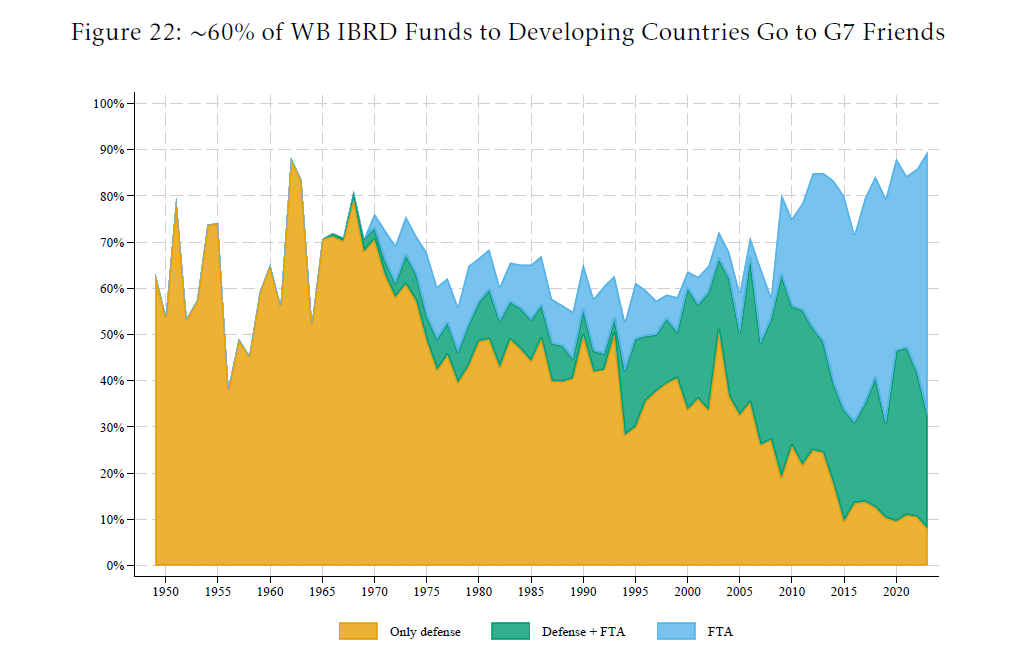
- Who benefits from international financing is systematically linked to who holds power. In institutions with concentrated voting structures, resources are disproportionately directed toward countries that are geopolitically aligned with the most powerful shareholders. Around 70% of World Bank lending is directed toward countries geopolitically aligned with the G7. These “friend” countries represent 52% of the developing world’s population and 48% of its GDP. The pattern is even starker for the IMF: 67% of loans go to G7-aligned countries, which account for only 6% of the population and 3% of GDP. By contrast, the United Nations, which operates under a more democratic governance structure, does not exhibit this pattern.
- These patterns are not new—and not inevitable. Current outcomes are shaped by institutional design, not by fixed economic necessities. Taken together, the evidence points to a clear mechanism: countries that face a lower cost of acquiring influence obtain greater voting power, contribute less relative to their income, and are better able to steer resources toward their geopolitical partners. This creates a systematic link between governance, financing, and allocation. This amounts to a global democratic deficit.International organizations exercise significant influence over economic outcomes worldwide, yet their decision-making structures often do not reflect the distribution of countries affected by their policies. Instead, institutional rules embed asymmetries that shape both who finances cooperation and who benefits from it, harming developing countries the most
POLICY RECOMMENDATIONS
Reforming governance is not only a matter of fairness—it is central to effectiveness. Institutions that concentrate power risk undermining the legitimacy of the global system and distorting resource allocation away from collective priorities. Moving toward more representative governance structures would help align contributions, decision-making, and outcomes, making international cooperation both more equitable and more credible.
The contrast across institutions shows that alternatives already exist. The key policy question is therefore not whether more democratic governance is feasible, but whether current arrangements—where influence, burden-sharing, and benefits are systematically tilted toward the most powerful—can be sustained.
- Future research should study the social optimal institutional design of international organizations
- GDP-weighted formulas that favor rich countries should be dropped
 |
 |
 |
 |
 |
 |
AUTHORS:
- Paula Druschke, Paris School of Economics, World Inequality Lab
- Gastón Nievas, Paris School of Economics, World Inequality Lab